
"Trim the Fat!"
Why the Chapel Hill Town Council is considering raising taxes

“Don’t tell me what you value, show me your budget and I’ll tell you what you value.” - Joe Biden
In my last post, I told y’all that I consider Council budget discussions complicated and heart-wrenching. That is especially so during these times of economic uncertainty. What I have gleaned from the letters we are getting is that some residents are not happy with the thought of taxes going up. But what is said also indicates that many don’t understand the budget and revenue situation. I can’t point fingers… I didn’t before I was on Council. But I’d like to share some of what I’ve learned and what I think — first, my conclusions, then more detail about the whys.
Our present tax rate is 59.4 cents per hundred dollars of property value, our revenue neutral rate would be 44.2, and the manager’s recommended rate, that I plan to vote for, is 50. Obviously, our national situation is uncertain, but the town is facing those financial uncertainties, too, with federally-funded programs at risk that we need to take into account. However, we can no longer cover growing costs with “nickel and dime” savings, and continuing to defer repair and replacement increases the inevitable costs. We also cannot continue to underpay our employees without repercussions. We made some progress addressing these issues last year, but we were counting on this year’s revaluation to help us “right size” our budget.
I know that higher taxes are not welcome. I’m proud that we have a program to help mitigate higher-tax impacts on our least advantaged homeowners, where even a smaller dollar increase could mean losing a generational home. However, if someone in a large valuable home loses their job, the marginal tax hike is unlikely to make their situation significantly more dire. Meanwhile, those with valuable properties who are financially secure can do their part to keep our Town running. In addition, Town services can help ease personal expenses. Any resident can ride the bus for free, and this service can replace a car, if need be. We have parks and pools that can replace vacations, if need be.
Council has heard from some unhappy taxpayers. But we also heard pleas from members of our community who depend on the services we provide. We heard from folks who realize that we pay for what we value and supported the budget. The Town Council is responsible for watching out for our whole community, its present wellbeing, and its future. I have agonized over this budget, and I believe that our services and programs are valuable to all our residents, and that it would be more detrimental in the long run to make the spending cuts that would be required to significantly reduce the budget and the tax rate.
I want to explain some of the information that brought me to this conclusion.
Our Revenues: Not being a Home Rule State, the NC General Assembly dictates where and how we get revenue. Property taxes and sales taxes are the two biggest sources, along with smaller sources like fees and grants. Revaluation gave us a chance to benefit from the added value to our property tax base. And, thankfully, we have some big properties that are paying good taxes. (E.g., the Berkshire on Elliot Rd is the third highest taxpayer in town) and in the next year or so, more will be opening, which will lessen tax pressure later. Had we built more density in past decades instead of primarily single family homes, our tax base would be more balanced with those higher value properties, and individual homeowners wouldn’t be so pinched (see the video at the bottom).
As to sales taxes, after wild pandemic spending, our sales tax revenues have flattened. Also, development has recently slowed, so we get less in fees from developers. And we may lose grant funding from the federal government, which Chapel Hill has always been good at getting. Bottom line, our income isn’t growing as fast as our costs. We need to strategically prepare for that and not base our budget on wishing for more.
It would be nice if we had more leeway on tax rates, for example, to have progressively higher rates for the highest value homes and businesses. But the General Assembly dictates that the same tax rate must apply to everyone, small or large home, residence or business.
Some things are paid out of “enterprise funds,” which means they have revenue besides our tax base. But they can be dependent on things like how many people are parking in the new deck or how many federal grants we receive.
What the budget covers: Going by Joe Biden’s metric, Chapel Hill values: taking care of our children, the disadvantaged and the underrepresented; the environment; effectively and efficiently keeping the town functioning; a robust local economy; a professional and dedicated workforce; and public safety. Fully half of our general fund budget goes to public works and public safety. Employees do the work, so they are a significant part of the budget. We have to pave streets, keep fleets running, and run services. Our values have led us to do work on affordable housing, climate action and resilience, and parks. (To better understand all the details, I heartily recommend folks listen to the manager’s explanations of the budget in Council presentations in April and May.)
The biggest enterprise fund is for transit, for which some residents have wanted us to charge fares, or to cut service. But our transit isn’t fare-free, per se, it’s actually pre-paid. To address the “why not charge fares” question, staff did an analysis, which showed that charging fares at boarding would actually end up costing us money. Partly because we don’t have fare-collection infrastructure, which is costly, and partly because our grant funding depends on ridership, which would fall significantly if we charged fares at boarding. Importantly, UNC pays the most for our transit system, partly with student fees. UNC would rather build new buildings on their land than more parking decks. So, UNC funds all of the costs for campus-only routes and shares the rest of the costs with the Towns of Chapel Hill and Carrboro. In addition, transit staff are GREAT at getting us grants for things like new buses and the coming Bus Rapid Transit system. Meanwhile, transit keeps traffic down and enables us to have less parking. Transit makes it possible for people to get to school/jobs, will allow folks to cut their own costs during rough times, AND cuts climate emissions and traffic. There are many benefits to maintaining our transit system.
Our other enterprise funds are parking, housing and stormwater. Stormwater fees are based on impervious surface on a property, and we are raising stormwater fees to address the growing issues of flooding in town.
Our employees are a big chunk of our budget, and they were behind the market in salaries because, to save raising taxes, they were not consistently given annual raises. So, some employees left. Understaffed departments create additional costs, like paying overtime for remaining staff or paying for private bus service when we didn’t have enough bus operators. Many of our employees can’t afford to live here, and commute here through cities that will pay them more. If we want to keep our exceptional Town employees, and for work to get efficiently done without disruption, we need to pay our workforce what they are worth. This budget will finally get them to market rate.
We do have a sort of savings account called the Fund Balance. Having enough in this reserve keeps our Bond Rating high and our borrowing rate low. We can and do borrow from it, as we can take money out to pay bills, then put it back when our irregular revenues arrive. However, if we raid it to cover costs without paying it back, it’s gone. Our financial position is more precarious the lower our fund balance gets.
Costs (Fat vs Muscle): Just like you are facing rising costs, so is the Town. The costs of everything, like new police cars, tires, fuel, and all kinds of equipment, are rising. Health insurance is up 6%. Maintenance that has been too long deferred to avoid raising taxes then, means that the problems have gotten worse and will cost more to fix now, or that lifecycle costs are higher because we’ve been repeatedly fixing old equipment instead of replacing them on schedule. This kind of savings is no longer tenable — those chickens have come home to roost.
Some residents feel there is fat in the budget. I guess that depends on what you want our Town to be. Our spending isn’t wasteful, it’s strategic to realize our goals. Since Covid, the Town Managers have tried to trim costs and our Interim Town Manager has been very strategic about how funds can be used — for example, lapsed salaries of departed staff were applied to cover cost increases, and software that can cut staff work has been implemented. We could do “nickel and dime” kinds of cuts across departments. But given cost increases, at this point the only way to cut our budget significantly is to continue to underpay our employees and to cut significantly into programs and to cut our strategic focus work.
So…. this takes us to the decision at hand, which I outlined up top. I believe that given all this, the recommended budget is the best option to serve our Town, now and into the future.
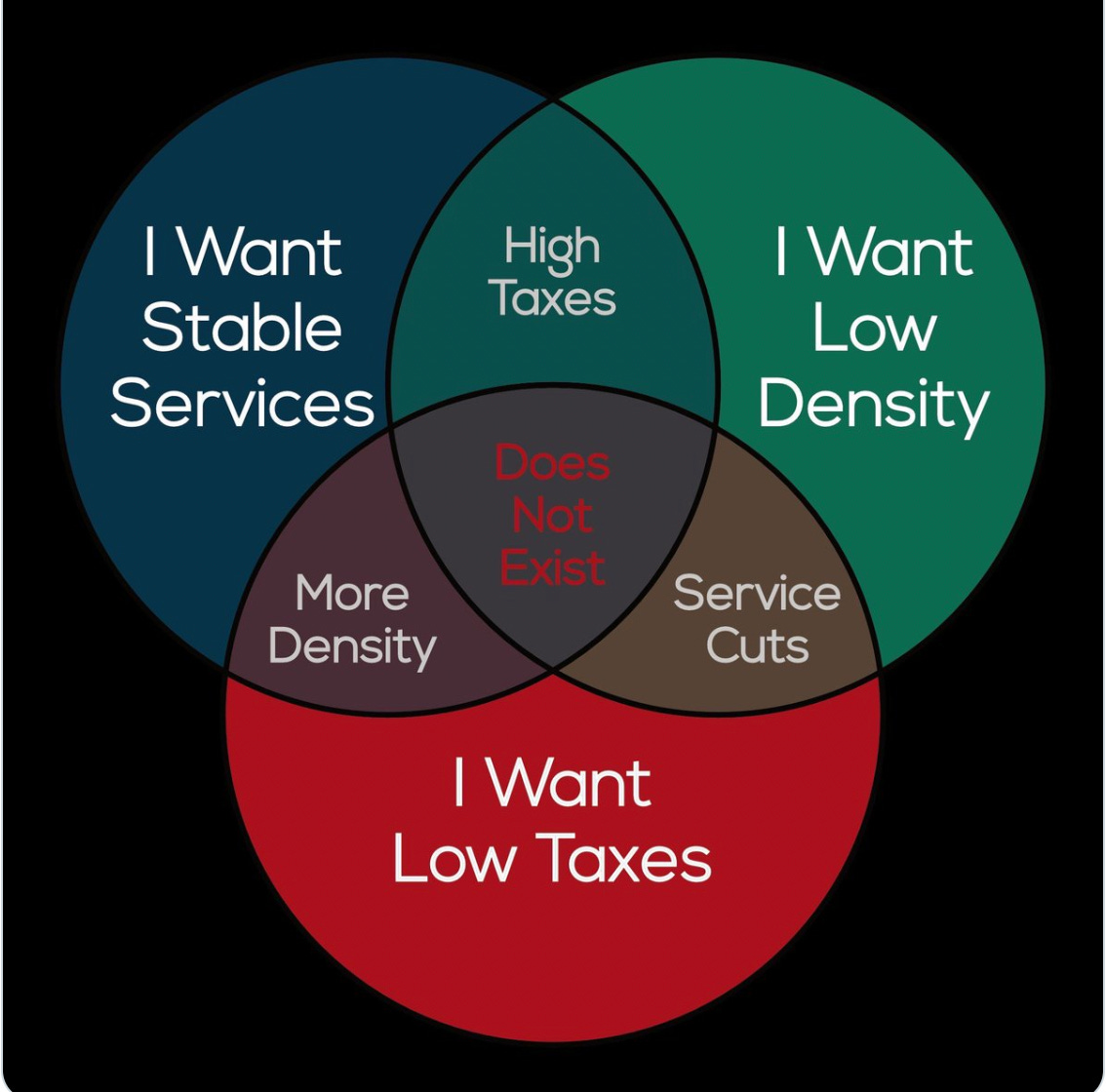
Graphic by Urban3, which specializes in “Financially Sustainable Communities by Design”.
With the reevaluation plus the rate hike my town property taxes will be increasing by 58%. I feel like you are being sort of glib with the first half of your post. Your post basically begins with the incorrect assumption that if you live in a house with a high assessment, you can afford significantly higher taxes. My neighborhood is pretty modest by Chapel Hill standards, and most of us did not buy our homes anywhere near our assessed rates (and more importantly for this discussion, could not afford to).
Thanks for trimming what you have trimmed. However, taxes are high here and the uncertainty make it a particularly bad time to raise them further, or as much as proposed.